Coming Soon
Our senior professionals will get back to you within 24 hours.
* First Name
Please provide a valid first name
* Last name
Please provide a valid last name
Please provide a valid email address
* Company name
Please provide a valid company name
* Phone number
Please provide a valid phone number
Country/Region
Please provide a valid country/region
Message
Please provide a valid message


You haven't submitted any information yet
Please complete all required fields


To Japanese business leaders considering a U.S. IPO
IPO Is Not the Finish Line—It Is Your Gateway to the Capital Markets
1. Why the U.S. Market?
1.1 The Structure of the Japanese Market: Equity Financing Begins—and Ends—with the IPO
The Tokyo Stock Exchange Growth Market has become Japan's largest IPO market, accounting for approximately 60–70% of all domestic IPOs in recent years. However, it is widely recognized as facing structural challenges, including a predominantly retail investor base, limited liquidity, relatively small fundraising sizes, and persistently weak post-listing share price performance.
As demonstrated by an empirical study published by the Japan Securities Research Institute in December 2025, recent Japanese IPOs are characterized by three distinct features:
• Secondary-offering driven
• Small fundraising size
• High first-day price appreciation
Since 2014, IPOs primarily consisting of secondary offerings have consistently represented more than half of all listings on the Mothers/Growth Market. In other words, Japanese IPOs have functioned less as a means of raising capital for the issuing company and more as an exit strategy for existing shareholders.
The same limitation exists after listing. Across the entire Tokyo Stock Exchange, only approximately 40 to 60 public offerings are conducted annually among roughly 3,900 listed companies—representing only about 1–2% of listed companies. According to Japan's Ministry of Economy, Trade and Industry (METI) Startup Finance Study Group, many Growth Market companies struggle to conduct secondary equity financings after going public.
For many Japanese companies, therefore, the IPO effectively becomes both their first and their last opportunity to raise equity capital.
1.2 The U.S. Market: A Market Companies Return to Again and Again
The U.S. market operates very differently.According to SEC statistics, during the first quarter of 2026:
• 99 IPOs raised more than $22 billion
• 264 registered follow-on offerings raised more than $44.2 billion
In other words, follow-on offerings exceeded IPOs by:
• approximately 2.7 times in number of transactions
• approximately 2 times in capital raised.
At an annualized pace of roughly 1,000 follow-on offerings, the U.S. capital market is fundamentally designed around the expectation that companies will repeatedly return to the market after going public.
Academic research consistently shows that approximately 30–40% of IPO companies complete at least one Seasoned Equity Offering (SEO) within five years after listing.
Among Nasdaq-listed biotechnology companies, it is not uncommon to conduct follow-on offerings or At-the-Market (ATM) offerings almost every year. The regulatory infrastructure—including Form S-3/F-3 shelf registration and ATM programs—enables companies to raise capital quickly, efficiently, and at relatively low cost whenever market conditions are favorable.
1.3 Structural Comparison
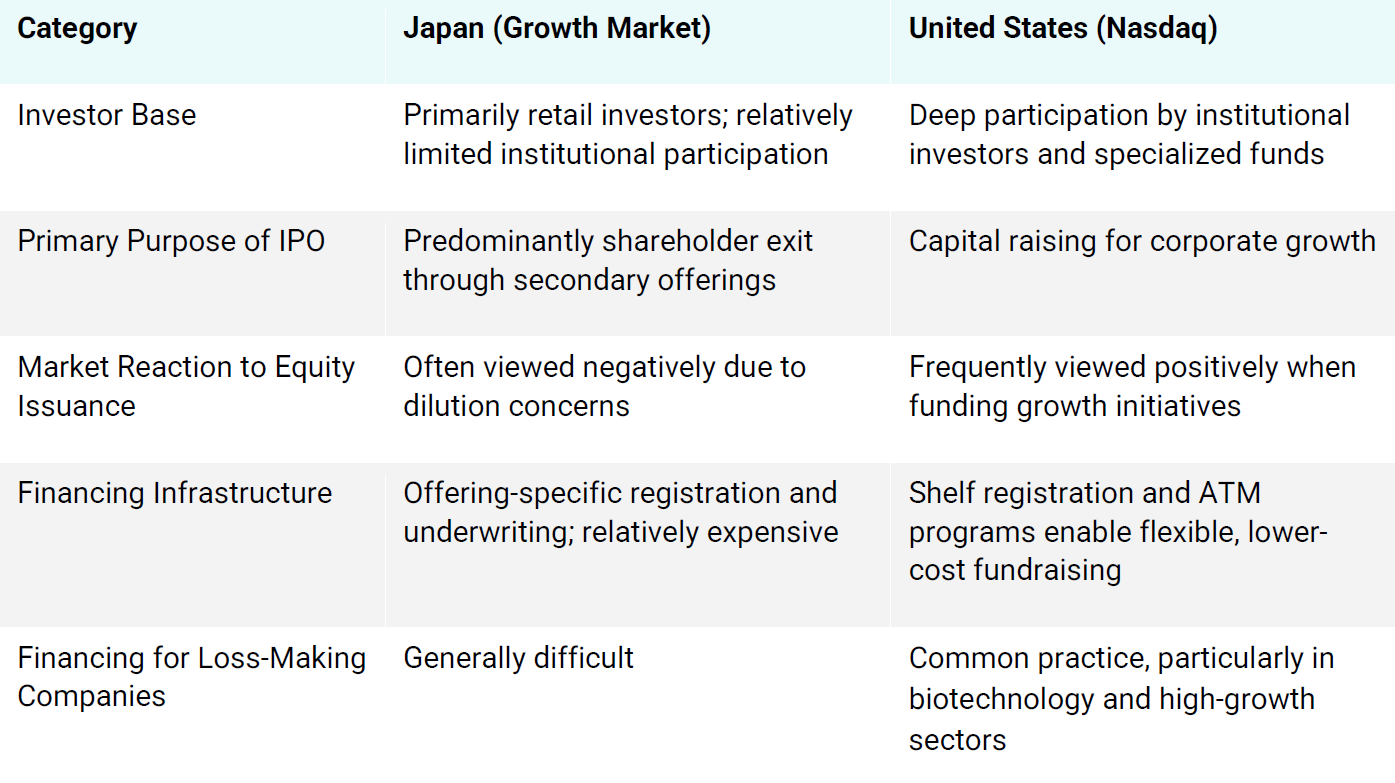
1.4 Moving Beyond the Mindset that "Equity Issuance Equals Share Price Decline"
Many Japanese executives have internalized the belief that issuing new shares inevitably leads to a decline in stock price because that has traditionally been the experience in Japan.
The U.S. market operates under a different philosophy.When capital is raised to fund future growth, investors frequently view equity issuance positively.This difference in market perception lies at the heart of the strategic value of a U.S. listing.
The American perspective is straightforward:
An IPO is not the destination—it is the gateway to continuous access to capital.
The true value of a U.S. listing is not simply the capital raised during the IPO itself, but the ongoing access to capital available through future follow-on offerings and ATM programs.
To benefit from these financing opportunities, however, a company must maintain sufficient trading liquidity. Achieving this requires a robust investor relations program that attracts institutional investors and fosters continuous engagement with the investment community.
Compared with Japan, U.S.-listed companies must communicate more proactively and consistently with the capital markets—particularly with institutional investors.
2. The Biggest Transformation Required of Management
Given the characteristics of the U.S. capital market, the greatest challenge facing executives pursuing a U.S. IPO is neither the size of the capital raise nor the complexity of the audit process.Rather, it is the transformation in management mindset required to operate successfully under SEC regulations and the expectations of the public markets.The capital access and financing opportunities offered by the U.S. market are inseparable from the rigorous financial reporting obligations designed to preserve market integrity, transparency, and shareholder value.
For newly public companies, the following become part of everyday business:
• Meeting SEC filing deadlines
• Complying with the Sarbanes-Oxley Act (SOX)
• Maintaining accountability to an expanded group of stakeholders—including the SEC, audit committees, independent auditors, Wall Street analysts, and investors.
For Japanese executives—particularly those whose companies have never before been publicly listed—this transition can be especially demanding.That is why well-prepared management teams begin thinking and operating like public-company executives from the moment they decide to pursue a listing.The 9 to 12 months preceding the IPO should be used to build:
• a capable finance organization,
• appropriate IT infrastructure
• reliable financial reporting systems.
These preparations form the foundation for successfully completing the IPO audit process and obtaining regulatory approval for listing.
3. Life After the IPO: Ongoing Disclosure and Internal Controls
3.1 Continuous Reporting Obligations
Once an SEC registration statement becomes effective, public companies become subject to continuous reporting obligations.
For most Japanese companies, which qualify as Foreign Private Issuers (FPIs):
• Annual reports are filed on Form 20-F within four months after fiscal year-end.
• Material information is disclosed through Form 6-K.
• Alternatively, FPIs may voluntarily use the domestic issuer reporting framework of Forms 10-K, 10-Q, and 8-K.
Although FPIs are not legally required to file quarterly reports on Form 10-Q, investors and analysts generally expect quarterly financial reporting. Consequently, companies should establish reporting capabilities comparable to those of U.S. domestic issuers.
For reference, U.S. domestic companies generally must file quarterly reports within 45 days after quarter-end (or 40 days for accelerated filers). Failure to meet filing deadlines may ultimately trigger delisting procedures following the limited extension available under Rule 12b-25.
Under this reporting regime, companies are expected to close their quarterly books in approximately 15 days.
Manual or semi-manual accounting systems and cash-based interim reporting processes are insufficient.
Instead, companies must invest in integrated reporting systems that automatically capture operational data within their accounting systems.
Japanese companies listed in the U.S. should likewise establish the capability to complete quarterly financial closes within approximately 15 days and make timely public disclosures.
3.2 Internal Controls: Management Owns the Process
Under the independence rules of the Public Company Accounting Oversight Board (PCAOB), external auditors cannot assist management in preparing financial statements or SEC filings.
Ownership of financial reporting, public disclosure, and remediation activities rests with management.
Management is responsible for:
• evaluating and reporting annually on the effectiveness of Internal Control over Financial Reporting (ICFR)
• having the CEO and CFO certify financial reports pursuant to Sections 302 and 906 of the Sarbanes-Oxley Act.
Except for certain exemptions, accelerated filers and large accelerated filers that do not qualify as Emerging Growth Companies (EGCs) must also obtain an auditor's attestation on the effectiveness of ICFR under Section 404(b).
The auditor's role is to independently evaluate and attest to the effectiveness of management's internal control system—not to create it.
The common framework for designing internal controls is the COSO Framework, consisting of five components and seventeen principles:
• Control Environment
• Risk Assessment (including fraud risk assessment)
• Control Activities
• Information and Communication
• Monitoring Activities
Developing these elements before the IPO is essential to sustaining investor confidence after becoming a public company.
4. Conclusion
A successful U.S. listing is not defined simply by completing an IPO.Its long-term value lies in maintaining strong internal controls, building a capable finance organization, and continuously engaging with the capital markets.Viewed this way, the IPO is merely the beginning.As your partner throughout this journey, MarcumAsia brings deep expertise in cross-border auditing and U.S. IPO advisory services to help guide your company every step of the way.
Sources and Notes:
The U.S. market statistics are based on SEC market data published in its July 1, 2026 press release, reporting 99 IPOs raising more than $22 billion and 264 registered follow-on offerings raising more than $44.2 billion during the first quarter of 2026. Offering counts may vary among data providers depending on methodologies such as the inclusion of SPAC transactions.
Japanese market data are based primarily on empirical research by the Japan Securities Research Institute and materials published by the Ministry of Economy, Trade and Industry's Startup Finance Study Group (including research conducted by Nomura Research Institute). The percentage of IPOs represented by the Growth Market varies by year (approximately 62% of general-market IPOs in 2025).
This publication is intended solely for general informational purposes and should not be construed as legal, tax, or accounting advice.
MarcumAsia is an independent public accounting firm with a strong focus on cross-border services for public and private companies. We are one of the leading audit and assurance service providers to Asian companies in the U.S. stock markets. MarcumAsia has extensive experience with transactions, including IPOs, SPAC mergers, M&A, and global expansion.

Manage Cookie Preferences
You can choose which types of cookies you allow. Your choices can be changed at any time through our Cookie Preferences settings.
These cookies are necessary for the website to function properly and cannot be switched off through our preference center. They may be used for website security, navigation, forms, session management, and other essential functions.
These cookies allow the website to remember choices you make, such as language or other preferences, and provide enhanced functionality.
These cookies help us understand how visitors interact with our website, including which pages are visited and how visitors navigate the site. We use this information to measure and improve website performance and user experience.